Rime
What is Rime?
Section titled “What is Rime?”Rime is a runtime for reproducible data work. You declare the pipeline once in pipeline.dag.yaml. Rime runs the graph, caches each node, captures logs, validates outputs, and writes artifacts.
specification_version: "2.1"
nodes:  - id: raw_orders    kind: sql    source: queries/load_orders.sql
  - id: order_metrics    kind: derive    inputs: [raw_orders]    as: revenue    expr: "[unit_price] * [quantity]"
  - id: sales_chart    kind: python    source: scripts/plot_sales.py    in:      orders: order_metrics
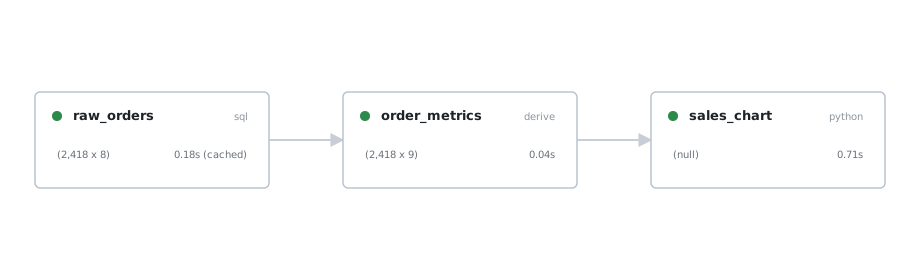
Here, SQL imports data, the derive node computes one reviewable feature with Rime’s expression language, and Python graphs the result. Rime captures intermediate data and script side effects, then produces a report with a runtime overview like this.
Why Rime
Section titled “Why Rime”⚡ Functions, not jobs
A node is a function over dataframes, not a task that wires I/O. You write what each step computes; the runtime owns reading, writing, serialization, and language boundaries. The dbt mental model, extended past SQL.
🧰 One DAG, four languages
SQL for joins, Python for ML, R for stats, JavaScript for everything else. Same pipeline, named slots, typed boundaries. Dataframes cross language borders through Arrow-backed payloads instead of ad hoc CSV handoffs.
🔒 Reproducible by default
Content-addressed caching, deterministic outputs, freeze-able snapshots. Same script plus same inputs means the same artifact, every time. No “works on my machine.”
📄 Publishable narratives
Render a publishable HTML report directly from your DAG. Tables, stats, stdout, figures, and node status: one render step, one document, one source of truth.
How Rime is different
Section titled “How Rime is different”- Airflow and Prefect orchestrate recurring jobs; Rime is local and one run.
- Reads, writes, retries, errors, and persistence are usually coded inside tasks.
- Rime owns dataframe handoff, execution order, caching, logs, validation, and outputs.
@taskdef load_orders():    orders = read_sql("SELECT * FROM orders")    orders.to_parquet("outputs/raw_orders.parquet")
@taskdef plot_sales():    orders = pd.read_parquet("outputs/raw_orders.parquet")    plot(orders)
@flowdef nightly_sales(): load_orders() plot_sales()nodes: - id: raw_orders kind: sql source: queries/load_orders.sql
- id: sales_chart kind: python source: scripts/plot_sales.py in: orders: raw_orders- Hex is a proprietary notebook-style workspace; Rime is open source and file-backed.
- Rime projects are portable
pipeline.dag.yamlfiles. - Rime’s Directed Acyclic Graph (DAG) is made of functions, not inline notebook modifications.
# SQL cell: raw_ordersSELECT *FROM warehouse.orders
# Python cell: order_metricsorder_metrics = raw_orders.copy()order_metrics["revenue"] = (    order_metrics["unit_price"] * order_metrics["quantity"])
# Python cell: sales_chartplot_sales(order_metrics)nodes: - id: raw_orders kind: sql source: queries/load_orders.sql
- id: order_metrics kind: derive inputs: [raw_orders] as: revenue expr: "[unit_price] * [quantity]"
- id: sales_chart kind: python source: scripts/plot_sales.py in: orders: order_metrics- Snakemake dependencies are based on files; Rime dependencies are based on nodes.
- Reads, writes, errors, and data persistence are usually coded manually in rules or scripts.
- Snakemake freshness is based mainly on file timestamps and metadata, not runtime-managed node identity.
rule load_orders:    output: "outputs/raw_orders.parquet"    shell: "python scripts/load_orders.py {output}"
rule plot_sales: input: "outputs/raw_orders.parquet" output: "outputs/sales.png" shell: "python scripts/plot_sales.py {input} {output}"nodes: - id: raw_orders kind: python source: scripts/load_orders.py
- id: sales_chart kind: python source: scripts/plot_sales.py in: orders: raw_ordersChoose your surface
Section titled “Choose your surface”The CLI consumes pipeline.dag.yaml today. The Editor will use the same file format when it is ready, so projects you build now will carry forward.